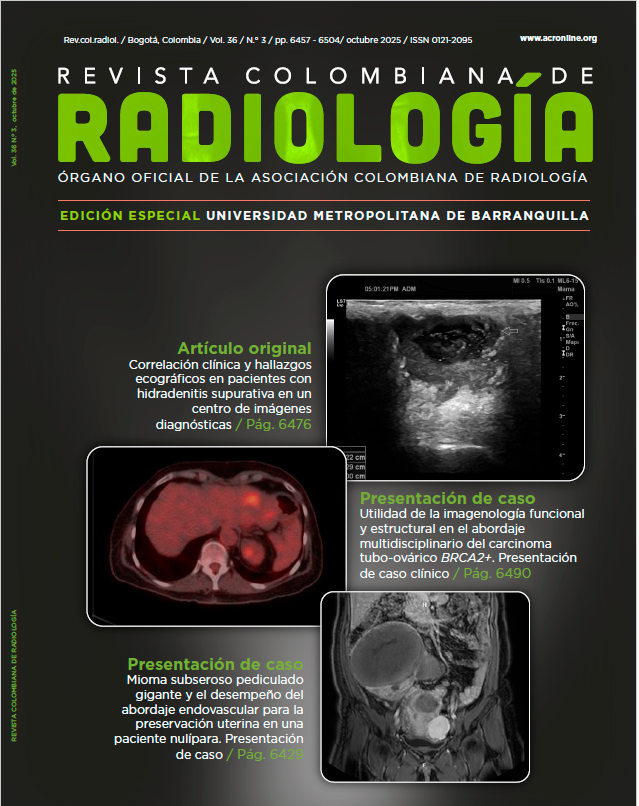
Giant pedunculated subserosal myoma and the performance of the endovascular approach for uterine preservation in a nulliparous patient. Case report
DOI:
https://doi.org/10.53903/01212095.420Keywords:
Uterine leiomyoma, Uterus, Magnetic resonance imaging, Uterine artery embolizationAbstract
The endovascular approach of selective embolization of the uterine arteries plays a fundamental role as a treatment for uterine myomatosis and nulliparous women who wish to preserve their uterus. However, its performance will depend on the location, size, and imaging characteristics of
the fibroid to be evaluated. The objective is to present uterine artery embolization as a therapeutic option for the management of large uterine myomas and satisfactory follow-up with contrastenhanced magnetic resonance imaging based on our experience with a clinical case. We report the case of a 45-year-old female patient who presented with hypogastric pain, metrorrhagia, and
an increase in abdominal volume over the pelvic region. Imaging studies showed an enlarged uterus with diameters of 20 x 17.8 x 22.7 cm, a volume of 4220 cc, and myomatous formations, the most dominant of which was subserosal, pedunculated, right-sided, 15 cm in size, and with a 4 cm
pedicle. Based on the above, a diagnosis of symptomatic giant uterine myomatosis was made, and hysterectomy was proposed as definitive management. However, due to the desire to preserve the uterus, endovascular therapy with selective embolization of the uterine arteries was proposed. At the 3-month follow-up, the patient reported significant improvement in pain, metrorrhagia, and the feeling of heaviness in the pelvic region. After 6 months, imaging was performed, showing a decrease in uterine size (2500 cc), allowing a 41 % reduction from the baseline volume. A follow-up was performed after one year with no changes in relation to the symptoms described.
Downloads
References
Guzmán EM, Mancilla Subdiaga B, et al. Mioma uterino gigante multilobulado: presentación inusual. Reporte de caso. Avanc Biomed. 2017;6(2):164-70.
Montañez MA, Higuera-García JS, Vargas-Rodríguez LJ. Mioma nascens: Reporte de Caso. Ginecol Obstet Mex. 2022;90(7):612-5.
Rivas M, Contente I, Navarro N, et al. Gran mioma uterino: manejo prequirúrgico con uso de agonistas de GNRH. Reporte de un Caso. Rev ANACEM. 2021;15(2):161-5.
Maciel C, Tang YZ, Sahdev A, et al. Preprocedural MRI and MRA in planning fibroid embolization. Diagn Interv Radiol. 2017;23(2):163-71.
Stokes LS, Wallace MB, Godwin RB, et al. Quality improvement guidelines for uterine artery embolization for symptomatic leiomyomata. J Vasc Interv Radiol. 2004;25(11):1737-47.
Koziarz A, Patel NR, Kennedy SA, et al. Uterine artery embolization for pedunculated subserosal fibroids: a systematic review and meta-analysis. J Vasc Interv Radiol. 2022;33(9):1025-31.
Katsumori T, Akazawa K, Mihara T. Uterine artery embolization for pedunculated subserosal fibroids. Am J Roentgenol. 2005;184(2):399-402.
Duvnjak S, Ravn P, Green A, et al. Magnetic resonance signal intensity ratio measurement before uterine artery embolization: ability to predict fibroid size reduction. Cardiovasc Intervent Radiol. 2017;40(12):1839-44.
Downloads
Published
How to Cite
Issue
Section
License
Copyright (c) 2026 Revista Colombiana de Radiología

This work is licensed under a Creative Commons Attribution-NonCommercial-ShareAlike 4.0 International License.
La Revista Colombiana de Radiología es de acceso abierto y todos sus artículos se encuentran libre y completamente disponibles en línea para todo público sin costo alguno.
Los derechos patrimoniales de autor de los textos y de las imágenes del artículo como han sido transferidos pertenecen a la Asociación Colombiana de Radiología (ACR). Por tanto para su reproducción es necesario solicitar permisos y se debe hacer referencia al artículo de la Revista Colombiana de Radiología en las presentaciones o artículos nuevos donde se incluyan.
| Article metrics | |
|---|---|
| Abstract views | 134 |
| Galley views | 58 |
| PDF Views | 58 |
| HTML views | 0 |
| Other views | 0 |