Comparison of volumetric and conventional sequences for the evaluation in magnetic resonance of the lumbar spine
DOI:
https://doi.org/10.53903/01212095.142Keywords:
Magnetic resonance imaging; low back pain; spinal cord; spinal nerve roots.Abstract
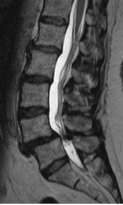
Objective: To compare the protocol that includes the three-dimensional SPACE-3D sequence with the conventional protocol in the magnetic resonance imaging (MRI) study of patients with low back pain. Methods: A prospective study of diagnostic tests was carried out, in which MR images of the lumbar spine were taken from 40 patients using a conventional protocol and another protocol that included
a volumetric sequence (SPACE-3D) in conjunction with axial T1 and sagittal STIR sequences, in a 1.5T resonator. The images were interpreted by two radiologists independently, both the conventional protocol and the protocol that included the volumetric sequence, one month apart. Both protocols were compared, calculating the sensitivity and specificity with the confidence interval (CI 95%), a value of p ≤0.05 using the Chi-square test was considered statistically significant. Variables such as the presence or absence of artifacts, disc protrusion/extrusion, narrowing of the central neural canal, lateral recess or root emergence foramen, and presence of radiculopathy, among others, were evaluated for both techniques. Inter- and intra-observer agreement was calculated using the Kappa index with a 95% CI. Results: it was found that the protocol that included the SPACE-3D sequence presents similar diagnostic performance (not inferior) when compared to the protocol with the conventional sequences for the variables evaluated, similarly, abnormal findings were detected, which allowed a complete study and diagnosis in less time. Conclusions: The diagnostic performance of the protocol that includes the SPACE-3D volumetric sequence is similar (not inferior) to the protocol with conventional sequences used in MRI of the lumbar spine and shortens the total study time.
Downloads
References
Tanitame N, Tanitame K, Awai K. Clinical utility of optimized three-dimensional T1-, T2-, and T2*-weighted sequences in spinal magnetic resonance imaging. Jpn J Radiol [Internet]. 2017 [citado: 2021 jul. 22];35(4):135-44. Disponible en: http://link.springer.com/10.1007/s11604-017-0621-3
Mugler JP, Bao S, Mulkern RV, Guttmann CRG, Robertson RL, Jolesz FA, et al. Optimized Single-Slab Three-dimensional Spin-Echo MR Imaging of the Brain. Radiology [Internet]. 2000 [citado: 2021 jul. 22];216(3):891-9. Disponible en: http://pubs.rsna.org/doi/10.1148/radiology.216.3.r00au46891
Lee S, Jee WH, Jung JY, Lee SY, Ryu KS, Ha KY. MRI of the lumbar spine: comparison of 3D isotropic turbo spin-echo SPACE sequence versus conventional 2D sequences at 3.0 T. Acta Radiol [Internet]. 2015 feb [citado: 2021 jul. 22];56(2):174-81. Disponible en: http://journals.sagepub.com/doi/10.1177/0284185114524196
Kijowski R, Davis KW, Blankenbaker DG, Woods MA, Del Rio AM, De Smet AA. Evaluation of the menisci of the knee joint using three-dimensional isotropic resolution fast spin-echo imaging: diagnostic performance in 250 patients with surgical correlation. Skeletal Radiol [Internet]. 2012 [citado: 2021 jul. 22];41(2):169-78. Disponible en: http://link.springer.com/10.1007/s00256-011-1140-4
Stevens KJ, Wallace CG, Chen W, Rosenberg JK, Gold GE. Imaging of the wrist at 1.5 tesla using isotropic three-dimensional fast spin echo cube. J Magn Reson Imaging [Internet]. 2011 [citado: 2021 jul. 22];33(4):908-15. Disponible en: https://onlinelibrary.wiley.com/doi/10.1002/jmri.22494
Hori M, Kim T, Onishi H, Ueguchi T, Tatsumi M, Nakamoto A, et al. Uterine tumors: comparison of 3D versus 2D T2-weighted Turbo Spin-Echo MR Imaging at 3.0 T—Initial Experience. Radiology [Internet]. 2011 [citado: 2021 jul. 22];258(1):154-63. Disponible en: http://pubs.rsna.org/doi/10.1148/radiol.10100866
Vertinsky AT, Krasnokutsky MV, Augustin M, Bammer R. Cutting-Edge Imaging of the Spine. Neuroimaging Clinics of North America [Internet]. 2007 [citado: 2021 jul. 22];17(1):117-36. Disponible en: https://linkinghub.elsevier.com/retrieve/pii/S1052514907000044
Kwon JW, Yoon YC, Choi SH. Three-dimensional isotropic T2-weighted cervical MRI at 3T: Comparison with two-dimensional T2-weighted sequences. Clinical Radiology [Internet]. 2012 [citado: 2021 jul. 22];67(2):106-13. Disponible en: https://linkinghub.elsevier.com/retrieve/pii/S000992601100300X
Sung J, Jee WH, Jung JY, Jang J, Kim JS, Kim YH, et al. Diagnosis of nerve root compromise of the lumbar spine: Evaluation of the performance of three-dimensional isotropic T2-weighted Turbo Spin-Echo SPACE Sequence at 3T. Korean J Radiol [Internet]. 2017 [citado: 2021 jul. 22];18(1):249. Disponible en: https://www.kjronline.org/DOIx.php?id=10.3348/kjr.2017.18.1.249
Tins B, Cassar-Pullicino V, Haddaway M, Nachtrab U. Three-dimensional sampling perfection with application-optimised contrasts using a different flip angle evolutions sequence for routine imaging of the spine: preliminary experience. BJR [Internet]. 2012 [citado: 2021 jul. 22];85(1016):e480-9. Disponible en: http://www.birpublications.org/doi/10.1259/bjr/25760339
Blizzard DJ, Haims AH, Lischuk AW, Arunakul R, Hustedt JW, Grauer JN. 3D-FSE isotropic MRI of the lumbar spine: Novel application of an existing technology. Journal of Spinal Disorders & Techniques [Internet]. 2015 [citado: 2021 jul. 22];28(4):152-7. Disponible en: https://journals.lww.com/00024720-201505000-00006
Swami VG, Katlariwala M, Dhillon S, Jibri Z, Jaremko JL. Magnetic resonance imaging in patients with mechanical low back pain using a novel rapid-acquisition three-dimensional SPACE Sequence at 1.5-T: A pilot study comparing lumbar stenosis assessment with routine two-dimensional magnetic resonance sequences. Can Assoc Radiol J [Internet]. 2016 [citado: 2021 jul. 22];67(4):368-78. Disponible en: http://journals.sagepub.com/doi/10.1016/j.carj.2015.11.005
Henschke N, Maher CG, Refshauge KM, Herbert RD, Cumming RG, Bleasel J, et al. Prevalence of and screening for serious spinal pathology in patients presenting to primary care settings with acute low back pain. Arthritis Rheum [Internet]. 2009 [citado: 2021 jul. 22];60(10):3072-80. Disponible en: https://onlinelibrary.wiley.com/doi/10.1002/art.24853
Modic M, Masaryk T, Boumphrey F, Goormastic M, Bell G. Lumbar herniated disk disease and canal stenosis: prospective evaluation by surface coil MR, CT, and myelography. American Journal of Roentgenology [Internet]. 1986 [citado: 2021 jul. 22];147(4):757-65. Disponible en: https://www.ajronline.org/doi/10.2214/ajr.147.4.757
Kijowski R, Gold GE. Routine 3D magnetic resonance imaging of joints. J Magn Reson Imaging [Internet]. 2011 Apr [citado: 2021 jul. 22];33(4):758-71. Disponible en: https://onlinelibrary.wiley.com/doi/10.1002/jmri.22342
Fu MC, Buerba RA, Neway WE, Brown JE, Trivedi M, Lischuk AW, et al. Threedimensional isotropic MRI of the cervical spine: A diagnostic comparison with conventional MRI. Clinical Spine Surgery: A Spine Publication [Internet]. 2016 [citado: 2021 jul. 22];29(2):66-71. Disponible en: https://journals.lww.com/01933606-201603000-00007
Meindl T, Wirth S, Weckbach S, Dietrich O, Reiser M, Schoenberg SO. Magnetic resonance imaging of the cervical spine: comparison of 2D T2-weighted turbo spin echo, 2D T2*weighted gradient-recalled echo and 3D T2-weighted variable flip-angle turbo spin echo sequences. Eur Radiol [Internet]. 2009 [citado: 2021 jul. 22];19(3):713-21. Disponible en: http://link.springer.com/10.1007/s00330-008-1175-7
Hossein J, Fariborz F, Mehrnaz R, Babak R. Evaluation of diagnostic value and T2-weighted three-dimensional isotropic turbo spin-echo (3D-SPACE) image quality in comparison with T2-weighted two-dimensional turbo spin-echo (2D-TSE) sequences in lumbar spine MR imaging. Eur J Radiol Open [Internet]. 2019 [citado: 2021 jul. 22];6:36-41. Disponible en: https://linkinghub.elsevier.com/retrieve/pii/S2352047718301138
Sartoretti E, Sartoretti T, Schwenk Á, Alfieri A, Czell D, Wyss M, et al. High-resolution 3D versus standard-resolution 2D T2-Weighted Turbo Spin Echo MRI for the assessment of lumbar nerve root compromise. Tomography [Internet]. 2021 [citado: 2021 jul. 22];8(1):257-66. Disponible en: https://www.mdpi.com/2379-139X/8/1/20
Downloads
Published
How to Cite
Issue
Section
License
Copyright (c) 2022 Revista Colombiana de Radiología

This work is licensed under a Creative Commons Attribution-NonCommercial-ShareAlike 4.0 International License.
La Revista Colombiana de Radiología es de acceso abierto y todos sus artículos se encuentran libre y completamente disponibles en línea para todo público sin costo alguno.
Los derechos patrimoniales de autor de los textos y de las imágenes del artículo como han sido transferidos pertenecen a la Asociación Colombiana de Radiología (ACR). Por tanto para su reproducción es necesario solicitar permisos y se debe hacer referencia al artículo de la Revista Colombiana de Radiología en las presentaciones o artículos nuevos donde se incluyan.