Duodenal injury secondary to blunt abdominal trauma, an injury that goes unnoticed. Case report with imaging approach
DOI:
https://doi.org/10.53903/01212095.254Keywords:
Multidetector computed tomography, Abdominal injuries, DuodenumAbstract
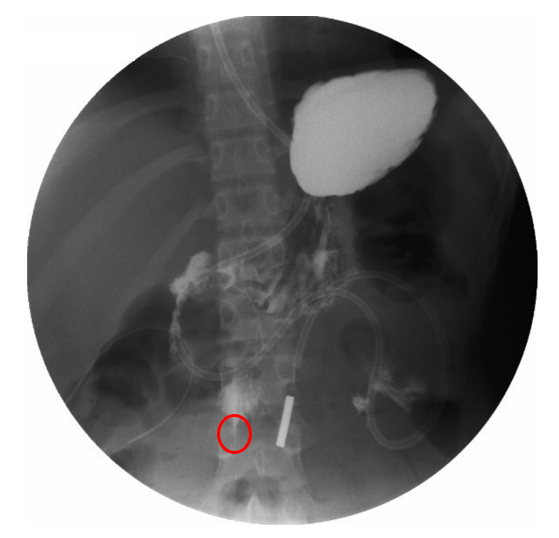
Introduction: Duodenal injuries due to blunt abdominal trauma are a challenging scenario as they have non-specific symptoms or can even be asymptomatic in the first hours. The objective of this article is to present the case of a 15-year-old patient with duodenal injury secondary to blunt abdominal trauma, from an imaging approach. Clinical case: A 15-year-old patient with blunt abdominal trauma secondary to being run over by a motorcycle as a pedestrian. CT findings suggest duodenal injury such as thickening of the walls, enhancement of the mucosa and laminar fluid. Intestinal transit evaluation identifies duodenal perforation, and MR cholangiopancreatography (MRCP) rules out bile duct injury. Conclusion: Traumatic duodenal injury is a complication that is rarely encountered but can constitute a diagnostic challenge for both the surgery and radiology groups.
Downloads
References
García Santos E, Soto Sánchez A, Verde JM, Marini CP, Asensio JA, Petrone P. Lesiones duodenales secundarias a traumatismo: Revisión de la Literatura. Cir Esp. 2015;93(2):68-74
Luo Y, He X, Geng L, Ouyang R, Xu Y, Liang Y, et al. Diagnosis and treatment of traumatic duodenal rupture in children. BMC Gastroenterol. 2022;22(1):61
Gosangi B, Rocha TC, Duran-Mendicuti A. Imaging spectrum of duodenal emergencies. Radiographics. 2020;40(5):1441-57.
Chirdan LB, Uba AF, Yiltok SJ, Ramyil VM. Paediatric blunt abdominal trauma: challenges of management in a developing country. Eur J Pediatr Surg. 2007;17(2):90-5
Zakarya AH, Mouna L, Loubna A, Houda O, Mounir E, Fouad E, et al. Duodenal trauma in children: What is the status of non-operative conservative treatment? Glob Pediatr Health. 2023;10:2333794X231156057
Bekker W, Kong VY, Laing GL, Bruce JL, Manchev V, Clarke DL. The spectrum and outcome of blunt trauma related enteric hollow visceral injury. Ann R Coll Surg Engl. 2018;100(4):290-4.
Ashi M, Saleh A, Albargi S, Babkour S, Banjar A, Ghazawi M. Isolated duodenal injury following blunt abdominal trauma. Radiol Case Rep. 2020;15(7):939-42.
Terra C, Ramos-Andrade D, Sá-Marques I, Brito J, Caseiro-Alves F, Curvo-Semedo L. Duodenal imaging on the spotlight: from A to Z. Insights Imag. 2021;12(1):94.
Genovese EA, Fonio P, Floridi C, Macchi M, Maccaferri A, Ianora AAS, et al. Abdominal vascular emergencies: US and CT assessment. Crit Ultrasound J. 2013;5(S1).
Moore EE, Cogbill TH, Malongoni MA, Jurkovich GJ, Champion HR, Gennarelli TA, et al. Organ injury scaling. II. Pancreas, duodenum, small bowel, colon and rectum. J Trauma. 1990:30:1427-9.
Ordóñez CA, Parra M, Millán M, Caicedo Y, Padilla N, García A, et al. Damage control in penetrating duodenal trauma: Less is better. Colombia Medica. 2021;52(2). https://doi.org/10.25100/cm.v52i2.4509
Downloads
Published
How to Cite
Issue
Section
License
Copyright (c) 2024 Revista Colombiana de Radiología

This work is licensed under a Creative Commons Attribution-NonCommercial-ShareAlike 4.0 International License.
La Revista Colombiana de Radiología es de acceso abierto y todos sus artículos se encuentran libre y completamente disponibles en línea para todo público sin costo alguno.
Los derechos patrimoniales de autor de los textos y de las imágenes del artículo como han sido transferidos pertenecen a la Asociación Colombiana de Radiología (ACR). Por tanto para su reproducción es necesario solicitar permisos y se debe hacer referencia al artículo de la Revista Colombiana de Radiología en las presentaciones o artículos nuevos donde se incluyan.