Atypical presentation of a central nervous system germinoma in a pediatric patient. Case presentation
DOI:
https://doi.org/10.53903/01212095.304Keywords:
Germinoma, Third ventricle, EndoscopyAbstract
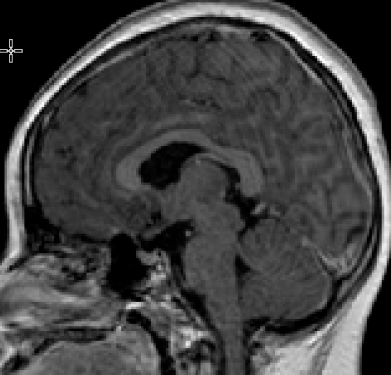
Introduction: Germinomas, although infrequent, are the most common germ cell tumors in the pediatric central nervous system (CNS). Unlike other germ cell tumors, they do not alter hormone levels in blood or cerebrospinal fluid. They are typically located in the pineal gland and the selarsuprasellar region, and are seen as expanding masses. They rarely affect vision, unless accompanied by intracranial hypertension. Objective: This study aims to describe an atypical presentation of a CNS germinoma manifesting as decreased visual acuity, associated only with thickening of the floor and anterior wall of the third ventricle, with invasion of the optic chiasm and optic nerves, a presentation not previously described in the literature. Case description: An 11-year-old female patient with short stature presented with decreased visual acuity and dyschromatopsia. Magnetic resonance imaging (MRI) revealed thickening and contrast enhancement of the optic chiasm and optic nerves, as well as the floor and anterior wall (lamina terminalis) of the third ventricle. The neurohypophysis was not visualized. An endoscopic biopsy of the floor of the third ventricle confirmed germinoma. The patient started oncologic treatment with carboplatin and etoposide according to the COG protocol. Conclusion: This case highlights the importance of considering germinoma in pediatric patients with atypical visual and neurologic symptoms. A comprehensive evaluation, including endoscopic biopsy in atypical cases, is crucial for accurate diagnosis and appropriate treatment. It is recommended to maintain a broad differential diagnosis, especially in cases with overlapping symptoms with other pathologies. This study contributes to the understanding of the clinical variability of CNS germinomas in pediatrics, emphasizing the need for further surveillance and study of these rare cases.
Downloads
References
Haloua M, Bouardi NE, Hbibi M, Alami BE, Lamrani YA, Maaroufi M, et al. Intracranial bifocal germinoma. Radiol Case Rep. 2022;17(9):3015-8. https://doi.org/10.1016/j.radcr.2022.05.080
Jennings MT, Gelman R, Hochberg F. Intracranial germ-cell tumors: natural history and pathogenesis. J Neurosurg. 1985;63(2):155-67. https://doi.org/10.3171/jns.1985.63.2.0155
Osorio DS, Allen JC. Management of CNS germinoma. CNS Oncol. 2015;4(4):273-9. https://doi.org/10.2217/cns.15.13. Epub 2015 Jun 29
Piette C, Hoyoux C, Luckers O, Tebache M. Atypical location of intracranial germinoma: a case report. Clin Neuroradiol. 2015;25(1):79-82. https://doi.org/10.1007/s00062-013-0274-2. Epub 2013 Dec 6
Wei XH, Shen HC, Tang SX, Gao CH, Ren JL, Ai L, et al. Radiologic features of primary intracranial ectopic germinomas: Case reports and literature review. Medicine (Baltimore). 2016;95(52):e5543. https://doi.org/10.1097/MD.0000000000005543
Shankar S, Wu X, Kalra VB, Huttner AJ, Malhotra A. Ectopic intracranial germinoma. J Clin Neurosci. 2016;31:192-5. https://doi.org/10.1016/j.jocn.2016.02.013. Epub 2016 Apr 2
Huang JH, Tsui I, Judkins AR, Simon E, Birknes JK, Sutton LN. Intramedullary cervical spine germinoma: case report. Neurosurgery. 2004;55(6):1432. PMID: 15574227
Jabłońska I, Goławski M, Nowicka E, Drosik-Rutowicz K, Trybus A, Tarnawski R, et al. Intracranial germinoma-association between delayed diagnosis, altered clinical manifestations, and prognosis. Cancers (Basel). 2023;15(10):2789 https://doi.org/10.3390/cancers15102789
Matsumura N, Kurimoto M, Endo S, Fukuda O, Takaku A. Intracranial germinoma associated with Down’s syndrome. Report of 2 cases. Pediatr Neurosurg. 1998;29(4):199-202. https://doi.org/10.1159/000028721
Fujita T, Yamada K, Saitoh H, Itoh S, Nakai O. Intracranial germinoma and Down’s syndrome--case report. Neurol Med Chir (Tokyo). 1992;32(3):163-5. https://doi.org/10.2176/nmc.32.163
Nakashima T, Nishimura Y, Sakai N, Yamada H, Hara A. Germinoma in cerebral hemisphere associated with Down syndrome. Childs Nerv Syst. 1997;13(10):563-6. https://doi.org/10.1007/s003810050139
Kremenevski N, Buchfelder M, Hore N. Intracranial germinomas: Diagnosis, pathogenesis, clinical presentation, and management. Curr Oncol Rep. 2023;25(7):765-75. https://doi.org/10.1007/s11912-023-01416-2. Epub 2023 Apr 10
Lian X, Hou X, Yan J, Sun S, Miao Z, Liu Z, et al. Treatment outcomes of intracranial germinoma: a retrospective analysis of 170 patients from a single institution. J Cancer Res Clin Oncol. 2019;145(3):709-15. https://doi.org/10.1007/s00432-018-2743-0.
Epub 2018 Sep 12
Downloads
Published
How to Cite
Issue
Section
License
Copyright (c) 2025 Revista Colombiana de Radiología

This work is licensed under a Creative Commons Attribution-NonCommercial-ShareAlike 4.0 International License.
La Revista Colombiana de Radiología es de acceso abierto y todos sus artículos se encuentran libre y completamente disponibles en línea para todo público sin costo alguno.
Los derechos patrimoniales de autor de los textos y de las imágenes del artículo como han sido transferidos pertenecen a la Asociación Colombiana de Radiología (ACR). Por tanto para su reproducción es necesario solicitar permisos y se debe hacer referencia al artículo de la Revista Colombiana de Radiología en las presentaciones o artículos nuevos donde se incluyan.