Post-laryngospasm pulmonary edema. A case report
DOI:
https://doi.org/10.53903/01212095.344Keywords:
pulmonary edema, laryngospasm, radiology (MeSH)Abstract
Negative Pressure Pulmonary Edema (NPPE) is a potentially fatal form of non-cardiogenic pulmonary edema that generally affects young individuals without comorbidities. The pathophysiology involves the development of negative intrathoracic pressure due to intense inspiratory effort and upper airway obstruction. In adults, the most common etiology is post-extubation laryngospasm in the
immediate postoperative period, affecting less than 0.1% of healthy patients undergoing general anesthesia. We present the case of a 22-year-old male patient with no comorbidities who was admitted to the emergency department with abdominal pain. Acute appendicitis was diagnosed, and an open appendectomy was performed without complications. The patient was extubated
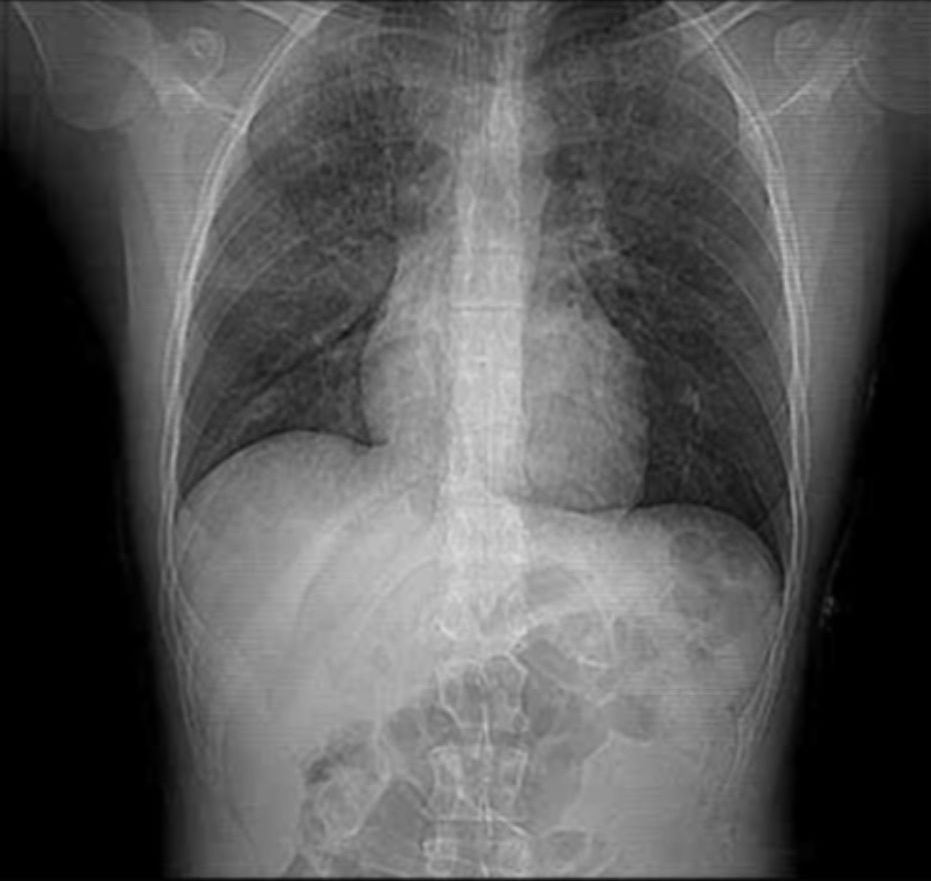
50 minutes after the start of surgery. Two hours later, he developed laryngospasm, with oxygen saturation levels of 88–90% without dyspnea. Despite an increase in oxygen flow, hypoxemia persisted, and a chest X-ray revealed multiple ground-glass opacities, suggesting pulmonary
edema. The patient was treated with furosemide and respiratory therapy. This reported case highlights the need to suspect a diagnosis of NPPE in young, healthy patients who develop acute hypoxemia in the immediate postoperative period, as this condition can be fatal if not promptly identified and treated.
Downloads
References
Tebay A, Bouti K, Tebay N. OEdème pulmonaire à pression négative après une cholécystectomie – à propos d’un cas. Revue de Pneumologie Clinique. 2017;73(5):267-71. https://doi.org/10.1016/j.pneumo.2017.08.006
Ma J, Liu T, Wang Q, Xia X, Guo Z, Feng Q, et al. Negative pressure pulmonary edema (Review). Exp Ther Med. 2023;26(3):455. https://doi.org/10.3892/etm.2023.12154
Lemyze M, Mallat J. Understanding negative pressure pulmonary edema. Intensive Care Med. 2014;40(8):1140-3. https://doi.org/10.1007/s00134-014-3307-7
Carels K, Herpels V, Cardoen L, Lecluyse C, Traen S, Verschakelen J. Postextubation pulmonary edema: an unusual cause of transient pulmonary edema. JBR-BTR. 2013;96(1):17-8. https://doi.org/10.5334/jbr-btr.165
Capitanio MA, Kirkpatrick JA. Obstructions of the upper airway in children as reflected on the chest radiograph. Radiology. 1973;107:159‑61.
Deepika K, Kenaan CA, Barrocas AM, Fonseca JJ, Bikazi GB. Negative pressure pulmonary edema after acute upper airway obstruction. J Clin Anesth. 1997;9:403‑8.
Tami TA, Chu F, Wildes TO, Kaplan M. Pulmonary edema and acute upper airway obstruction. Laryngoscope. 1986;96(5):506-9. https://doi.org/10.1288/00005537-198605000-00007
Ben-David Y, Bentur L, Gur M, Ilivitzki A, Toukan Y, Nir V, et al. Pediatric negative pressure pulmonary edema: Case series and review of the literature. Pediatr Pulmonol. 2023;58(12):3596-9. https://doi.org/10.1002/ppul.26700
Goodman LR, Fumagalli R, Tagliabue P, Tagliabue M, Ferrario M, Gattinoni L, et al. Adult respiratory distress syndrome due to pulmonaray and extrapulmonary causes: CT, clinical, and functional correlations. Radiology. 1999;213(2):545-52. https://doi.org/10.1148/radiology.213.2.r99nv42545
Karaman I, Ozkaya S. Differential diagnosis of negative pressure pulmonary edema during COVID-19 pandemic. J Craniofac Surg. 2021;32(5):e421-3. https://doi.org/10.1097/SCS.0000000000007226
Bhaskar B, Fraser JF. Negative pressure pulmonary edema revisited: Pathophysiology and review of management.
Downloads
Published
How to Cite
Issue
Section
License
Copyright (c) 2025 Revista Colombiana de Radiología

This work is licensed under a Creative Commons Attribution-NonCommercial-ShareAlike 4.0 International License.
La Revista Colombiana de Radiología es de acceso abierto y todos sus artículos se encuentran libre y completamente disponibles en línea para todo público sin costo alguno.
Los derechos patrimoniales de autor de los textos y de las imágenes del artículo como han sido transferidos pertenecen a la Asociación Colombiana de Radiología (ACR). Por tanto para su reproducción es necesario solicitar permisos y se debe hacer referencia al artículo de la Revista Colombiana de Radiología en las presentaciones o artículos nuevos donde se incluyan.