Pictorial review with representative cases of CAD-RADS 2.0 classification in stable coronary artery disease
DOI:
https://doi.org/10.53903/01212095.360Abstract
Background: The Coronary Artery Disease Reporting and Data System (CAD-RADS) is a structured reporting framework designed to standardize coronary computed tomography angiography (CCTA) interpretations. A lack of standardized reporting can impede interdisciplinary communication and contribute to variability in clinical management. The implementation of CAD-RADS 2.0
contributes to standardizing CCTA reporting, reducing variability in interpretation and improving interdisciplinary communication, facilitating more accurate management of coronary artery disease. Objective: To describe and illustrate with our own cases the CAD-RADS 2.0 Reporting System to facilitate the understanding and application of this classification. Methods: A retrospective filtered search was conducted in our institution’s archive for patients who underwent CCTA between June 2, 2023, and March 26, 2024. Two cardiac imaging radiologists with more than 15 years of
experience reviewed the CCTA reports, the CAD-RADS 2.0 classification, and images for each patient in the archive, selecting by consensus the cases characteristic of each CAD-RADS 2.0 category to illustrate the application of this reporting system in a representative manner. Results:
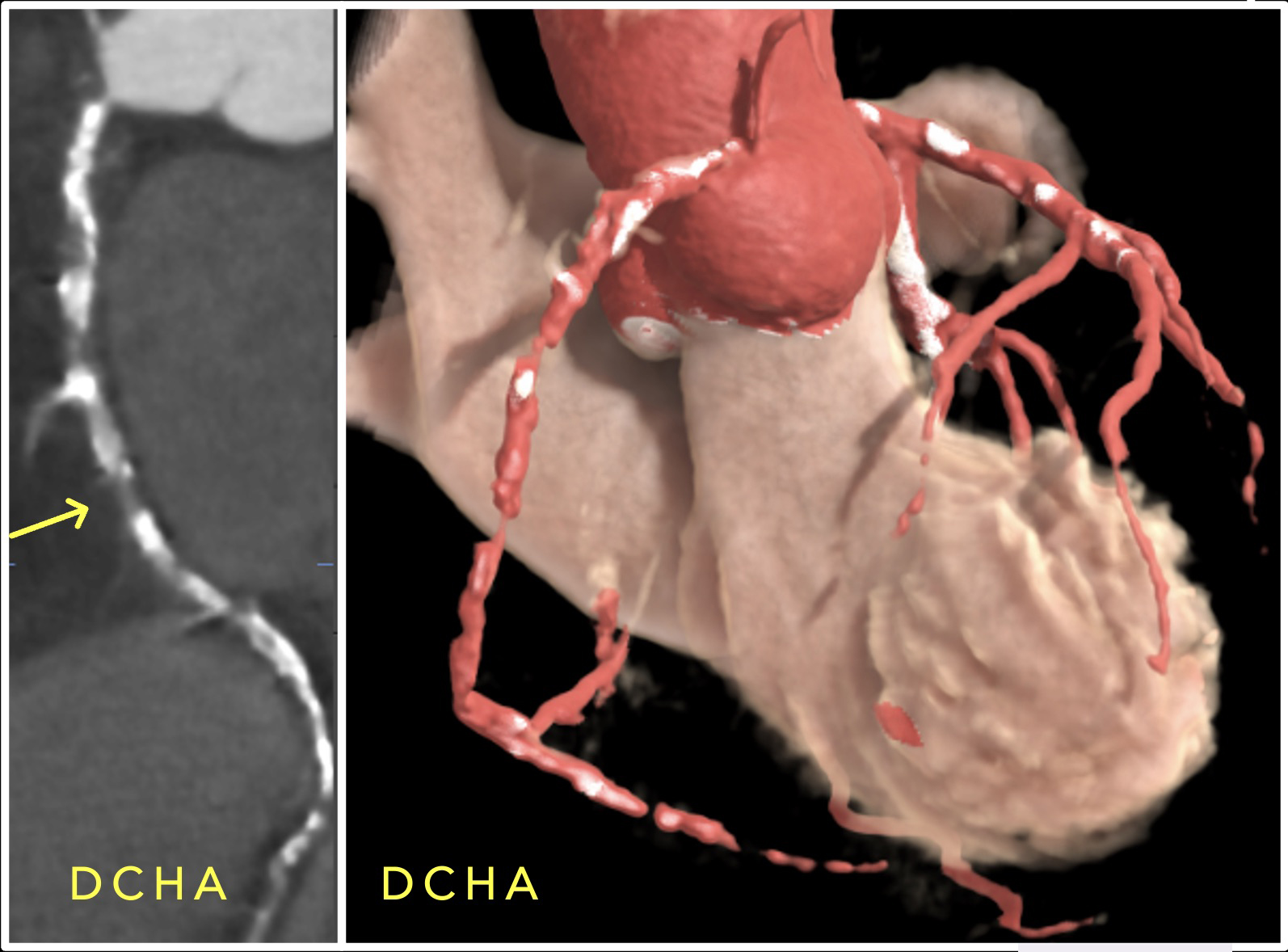
Representative cases from the different categories of the updated CAD-RADS 2.0 classification were selected. Illustrations were included to facilitate the understanding of coronary anatomy and the characteristics of the different coronary lesions. Conclusion: The pictorial review provides a comprehensive and educational resource for understanding and applying the CAD-RADS 2.0 report system, combining a complete description of its categories and modifiers with high-quality images obtained through the clinical use of a state-of-the-art 320 detector row CT scanner in our Colombian population.
Downloads
References
Ramanathan S, Al Heidous M, Alkuwari M. Coronary artery disease-reporting and data system (CAD-RADS): strengths and limitations. Clin Radiol. 2019;74(6):411-7. https://doi.org/10.1016/j.crad.2019.01.003.
Cury RC, Blankstein R, Leipsic J, Abbara S, Achenbach S, Berman D, et al. CADRADSTM 2.0 - 2022 Coronary Artery Disease – Reporting and Data System an expert consensus document of the Society of Cardiovascular Computed Tomography (SCCT), the American College of Cardiology (ACC), the American College of Radiology (ACR) and the North America Society of Cardiovascular Imaging (NASCI). J Cardiovasc Comput Tomogr. 2022;0. https://doi.org/10.1016/j.jcct.2022.07
Canan A, Ranganath P, Goerne H, Abbara S, Landeras L, Rajiah P. CAD-RADS: Pushing the limits. Radiographics. 2020;40:629-52. https://doi.org/10.1148/rg.2020190164.
Cury RC, Abbara S, Achenbach S, Agatston A, Berman DS, Budoff MJ, et al. CADRADS ™: Coronary Artery Disease - Reporting and Data System: An Expert Consensus Document of the Society of Cardiovascular Computed Tomography (SCCT), the American College of Radiology (ACR) and the North American Society for Cardiovascular Imaging (NASCI). Endorsed by the American College of Cardiology. JACR. 2016;13(12 Pt A):1458-1466.e9. https://doi.org/10.1016/j.jacr.2016.04.024
Leipsic J, Abbara S, Achenbach S, Cury R Earls, JP, Mancini GJ, et al. SCCT guidelines for the interpretation and reporting of coronary CT angiography: a report of the Society of Cardiovascular Computed Tomography Guidelines Committee. J Cardiovasc Comp Tomogr. 2014;8(5):342-58. https://doi.org/10.1016/j.jcct.2014.07.003
Austen WG, Edwards JE, Frye RL, Gensini GG, Gott VL, Griffith LS, et al. A reporting system on patients evaluated for coronary artery disease. Report of the Ad Hoc Committee for Grading of Coronary Artery Disease, Council on Cardiovascular Surgery, American Heart Association. Circulation. 1975:51(4 Suppl):5-40. https://doi.org/10.1161/01.cir.51.4.5
Xie JX, Cury RC, Leipsic J, Crim MT, Berman DS, Gransar H, et al. The Coronary Artery Disease–Reporting and Data System (CAD-RADS): prognostic and clinical implications associated with standardized coronary computed tomography angiography reporting. JACC Cardiovasc Imaging. 2018;11:78-89. https://doi.org/10.1016/J.JCMG.2017.08.026
Shingo K, Mai A, Nobuyuki H, Daisuke U. Prognostic significance of CAD-RADS for patients with suspected coronary artery disease: A systematic review and meta-analysis. Radiol Advanc. 2024;1(1): umae007. https://doi.org/10.1093/radadv/umae007
Patel AR, Bamberg F, Branch K, Carrascosa P, Chen M, Cury RC, et al. Society of cardiovascular computed tomography expert consensus document on myocardial computed tomography perfusion imaging. J Cardiovasc Comput Tomogr. 2020;14:87- 100. https://doi.org/10.1016/J.JCCT.2019.10.003
Rajiah P, Cummings KW, Williamson E, Young PM. CT fractional flow reserve: A practical guide to application, interpretation, and problem solving. Radiographics. 2022;42:340-58. https://doi.org/10.1148/RG.210097
Downloads
Published
How to Cite
Issue
Section
License
Copyright (c) 2026 Revista Colombiana de Radiología

This work is licensed under a Creative Commons Attribution-NonCommercial-ShareAlike 4.0 International License.
La Revista Colombiana de Radiología es de acceso abierto y todos sus artículos se encuentran libre y completamente disponibles en línea para todo público sin costo alguno.
Los derechos patrimoniales de autor de los textos y de las imágenes del artículo como han sido transferidos pertenecen a la Asociación Colombiana de Radiología (ACR). Por tanto para su reproducción es necesario solicitar permisos y se debe hacer referencia al artículo de la Revista Colombiana de Radiología en las presentaciones o artículos nuevos donde se incluyan.
| Article metrics | |
|---|---|
| Abstract views | 447 |
| Galley views | 211 |
| PDF Views | 211 |
| HTML views | 0 |
| Other views | 0 |