Cerebral air embolism as an immediate complication of percutaneous lung biopsy
DOI:
https://doi.org/10.53903/01212095.361Keywords:
Lung, Air embolism, Lung biopsy, Computed tomographyAbstract
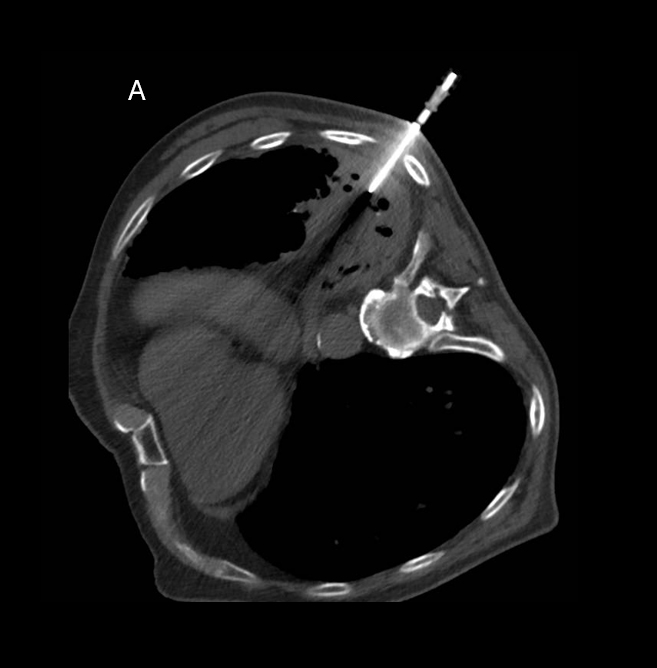
Air embolism occurs when air or gas enters the bloodstream, either venous or arterial. Although rare, this condition is potentially fatal, and its incidence is increasing due to the rise in interventional procedures. In the past, the primary causes of air embolism were trauma and major surgeries. Currently, minimally invasive procedures, such as digestive endoscopies, angiographic studies, percutaneous biopsies, thoracocentesis, and the insertion of central venous or hemodialysis catheters, are the leading causes. The aim of this study is to present a case of cerebral air embolism that occurred immediately after a CT-guided percutaneous lung biopsy, resulting in severe neurological damage and a fatal outcome for the patient.
Downloads
References
McCarthy CJ, Behravesh S, Naidu SG, Oklu R. Air embolism: Diagnosis, clinical management and outcomes. Diagnostics. 2017;7(1):5. https://doi.org/10.3390/diagnostics7010005
Bessereau J, Genotelle N, Chabbaut C, Huon A, Tabah A, Aboab J, et al. Long-term outcome of iatrogenic gas embolism. Intensive Care Med. 2010;36(7):1180-7. https://doi.org/10.1007/s00134-010-1821-9
Freund MC, Petersen J, Goder KC, Bunse T, Wiedermann F, Glodny B. Systemic air embolism during percutaneous core needle biopsy of the lung: Frequency and risk factors. BMC Pulm Med. 2012;12. https://doi.org/10.1186/1471-2466-12-2
Pinho J, Amorim JM, Araújo JM, Vilaça H, Ribeiro M, Pereira J, et al. Cerebral gas embolism associated with central venous catheter: Systematic review. J Neurol Sci. 2016;362:160-4. https://doi.org/10.1016/j.jns.2016.01.043
Wang S, Zhong F, Liao M, Zhang H. Risk factors for air embolism following computed tomography-guided percutaneous transthoracic needle biopsy: a systematic review and meta-analysis. Diagn Intervent Radiol. 2023;29:478-91. https://doi.org/10.4274/dir.2022.221187
Timpone VM, Callen AL. Characteristic MR imaging findings of cerebral air embolism infarcts: a case series. Am J Neuroradiol. 2024;ajnr.A8349. https://doi.org/10.3174/ajnr.A8349
Brown AE, Rabinstein AA, Braksick SA. Clinical characteristics, imaging findings, and outcomes of cerebral air embolism. Neurocrit Care. 2023;38(1):158-64. https://doi.org/10.1007/s12028-022-01664-3
Zangan SM, Yu Q. Review of air embolism for the interventional radiologist. Arab J Intervent Radiol. 2024;8(1):6-12. https://doi.org/10.1055/s-0043-1777810
Downloads
Published
How to Cite
Issue
Section
License
Copyright (c) 2025 Revista Colombiana de Radiología

This work is licensed under a Creative Commons Attribution-NonCommercial-ShareAlike 4.0 International License.
La Revista Colombiana de Radiología es de acceso abierto y todos sus artículos se encuentran libre y completamente disponibles en línea para todo público sin costo alguno.
Los derechos patrimoniales de autor de los textos y de las imágenes del artículo como han sido transferidos pertenecen a la Asociación Colombiana de Radiología (ACR). Por tanto para su reproducción es necesario solicitar permisos y se debe hacer referencia al artículo de la Revista Colombiana de Radiología en las presentaciones o artículos nuevos donde se incluyan.