Comparison of the diagnostic performance of MRI/ultrasound fusion-guided prostate biopsy versus ultrasound-guided prostate biopsy in patients with suspected prostate cancer
DOI:
https://doi.org/10.53903/01212095.314Keywords:
Prostatic neoplasms, Prostate biopsy, Magnetic resonance imaging, UltrasonographyAbstract
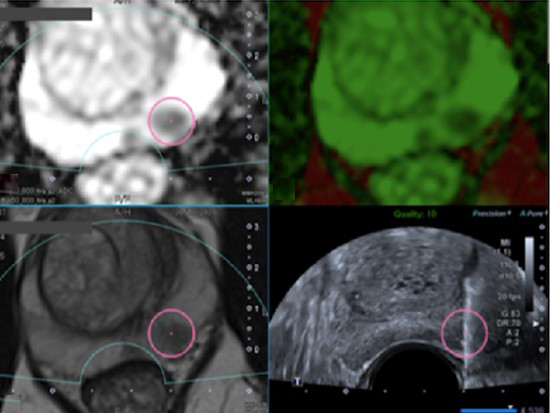
Introduction: Transrectal ultrasound-guided prostate biopsy has been the diagnostic standard for prostate cancer. However, this technique may miss clinically significant lesions. MRI/ultrasound fusion-guided biopsy allows targeted sampling of suspicious lesions previously identified by imaging. Objective: To evaluate the diagnostic performance of MRI/ultrasound fusion-guided prostate biopsy compared to conventional ultrasound-guided biopsy for the detection of clinically significant prostate cancer. Methods: A cross-sectional diagnostic validation study was conducted at a specialized imaging center in Medellín, Colombia, between January and December 2020. A total of 115 patients with suspected prostate cancer (PSA > 3 ng/mL or abnormal digital rectal exam) underwent multiparametric MRI followed by both fusion-guided and conventional biopsies. The reference standard was the conventional biopsy. Sensitivity, specificity, and predictive values were calculated, and the detection of clinically significant cancer (Gleason ≥7) was compared between techniques. Results: A total of 115 patients with suspicious findings on multiparametric MRI (PIRADS ≥ 3) were included in the analysis. The MRI/ultrasound fusion-guided biopsy demonstrated a sensitivity of 91.7 %, specificity of 81.6 %, positive predictive value (PPV) of 36.7 %, and negative predictive value (NPV) of 98.2 %. Clinically significant cancer (Gleason ≥ 7) was detected in 26.1 % of cases with fusion biopsy, compared to 10.4 % with the conventional technique, with a statistically significant difference (p < 0.0001). Conclusion: MRI/ ultrasound fusion-guided prostate biopsy improves the detection of high-grade carcinomas compared to the conventional technique. Its use may enhance early diagnosis and timely treatment of clinically significant prostate cancer.
Downloads
References
Ministerio de Salud Colombia. Guía de práctica clínica para la detección temprana, diagnóstico, tratamiento, seguimiento y rehabilitación del cáncer de próstata. Ministerio de Salud y Protección Social. Departamento Administrativo de Ciencia y Tecnología e Innovación en Salud (Colciencias); 2013.
Bray F, Ferlay J, Soerjomataram I, Siegel RL, Torre LA, Jemal A. Global cancer statistics 2018: GLOBOCAN estimates of incidence and mortality worldwide for 36 cancers in 185 countries. CA Cancer J Clin. 2018;68(6):394-424. http://doi.wiley.com/10.3322/caac.21492.
National Cancer Institute. Cancer statistics review 1975-2016: introduction [internet]. 2016. Disponible en: https://seer.cancer.gov/statfacts/html/prost.html.
Sivaraman A, Sánchez-Salas R, Castro-Marín M, Barret E, Guillot-Tantay C, Prapotnich D, et al. Evolución de las técnicas de biopsia prostática. Mirando hacia atrás en un viaje significativo. Actas Urológicas Españolas. 2016;40(8):492-8. https://doi.org/10.1016/j.acuro.2016.02.011.
Das CJ, Razik A, Sharma S, Verma S. Prostate biopsy: when and how to perform. Clin Radiol. 2019;74(11):853-64. https://doi.org/10.1016/j.crad.2019.03.016.
Raja J, Ramachandran N, Munneke G, Patel U. Current status of transrectal ultrasoundguided prostate biopsy in the diagnosis of prostate cancer. Clin Radiol. 2006;61(2):142-53. https://doi.org/10.1016/j.crad.2005.10.002.
Pahwa S, Schiltz NK, Ponsky LE, Lu Z, Griswold MA, Gulani V. Cost-effectiveness of MR Imaging-guided Strategies for Detection of Prostate Cancer in Biopsy-Naive Men. Radiology. 2017;285(1):157-66. https://doi.org/10.1148/radiol.2017162181.
Verma S, Choyke PL, Eberhardt SC, Oto A, Tempany CM, Turkbey B, et al. The current state of mr imaging–targeted biopsy techniques for detection of prostate cancer. Radiology. 2017;285(2):343-56. https://doi.org/10.1148/radiol.2017161684.
Chang SD, Ghai S, Kim CK, Oto A, Giganti F, Moore CM. MRI targeted prostate biopsy techniques: AJR Expert Panel Narrative Review. Am J Roentgenol. 2021;217(6):1263-81. https://doi.org/10.2214/AJR.21.26154.
Goldberg H, Ahmad AE, Chandrasekar T, Klotz L, Emberton M, Haider MA, et al. Comparison of magnetic resonance imaging and transrectal ultrasound informed prostate biopsy for prostate cancer diagnosis in biopsy naïve men: a systematic review and meta-analysis. J Urol. 2020;203(6):1085-93. https://doi.org/10.1097/JU.0000000000000595.
Brown LC, Ahmed HU, Faria R, El-Shater Bosaily A, Gabe R, Kaplan RS, et al. Multiparametric MRI to improve detection of prostate cancer compared with transrectal ultrasound-guided prostate biopsy alone: the PROMIS study. Health Technol Assess. 2018;22(39):1-176. https://doi.org/10.3310/hta22390.
Djavan B, Ravery V, Zlotta A, Dobronski P, Dobrovits M, Fakhari M, et al. Prospective evaluation of prostate cancer detected on biopsies 1, 2, 3 and 4: when should we stop? J Urol. 2001;166(5):1679-83. PMID: 11586201.
Scattoni V, Zlotta A, Montironi R, Schulman C, Rigatti P, Montorsi F. Extended and saturation prostatic biopsy in the diagnosis and characterisation of prostate cancer: a critical analysis of the literature. Eur Urol. 2007;52(5):1309-22. https://doi.org/10.1016/j.eururo.2007.08.006.
Siddiqui MM, Rais-Bahrami S, Turkbey B, George AK, Rothwax J, Shakir N, et al. Comparison of mr/ultrasound fusion–guided biopsy with ultrasound-guided biopsy for the diagnosis of prostate cancer. JAMA. 2015;313(4):390. https://doi.org/10.1001/jama.2014.17942.
Padhani AR, Barentsz J, Villeirs G, Rosenkrantz AB, Margolis DJ, Turkbey B, et al. PI-RADS Steering Committee: The PI-RADS Multiparametric MRI and MRIdirected biopsy pathway. Radiology. 2019;292(2):464-74. https://doi.org/10.1148/radiol.2019182946.
Mortezavi A, Märzendorfer O, Donati OF, Rizzi G, Rupp NJ, Wettstein MS, et al. Diagnostic accuracy of multiparametric magnetic resonance imaging and fusion guided targeted biopsy evaluated by transperineal template saturation prostate biopsy for the detection and characterization of prostate cancer. J Urol. 2018;200(2):309-18. https://doi.org/10.1016/j.juro.2018.02.067.
Cornud F, Roumiguié M, Barry de Longchamps N, Ploussard G, Bruguière E, Portalez D, et al. Precision Matters in MR imaging-targeted prostate biopsies: evidence from a prospective study of cognitive and elastic fusion registration transrectal biopsies. Radiology. 2018;287(2):534-42. https://doi.org/10.1148/radiol.2017162916
Moore CM, Kasivisvanathan V, Eggener S, Emberton M, Fütterer JJ, Gill IS, et al. Standards of reporting for MRI-targeted Biopsy Studies (START) of the prostate: recommendations from an International Working Group. Eur Urol. 2013;64(4):544-52. https://doi.org/10.1016/j.eururo.2013.03.030.
Kasivisvanathan V, Rannikko AS, Borghi M, Panebianco V, Mynderse LA, Vaarala MH, et al. MRI-targeted or standard biopsy for prostate-cancer diagnosis. N Engl J Med. 2018;378(19):1767-77. https://org/doi/10.1056/NEJMoa1801993.
Turkbey B, Rosenkrantz AB, Haider MA, et al. Prostate Imaging Reporting and Data System Version 2.1: 2019 Update of Prostate Imaging Reporting and Data System Version 2. Eur Urol. 2019;76(3):340-51. https://doi.org/10.1016/j.eururo.2019.02.033.
Costa DN, Pedrosa I, Donato F, Roehrborn CG, Rofsky NM. MR Imaging–Transrectal US fusion for targeted prostate biopsies: implications for diagnosis and clinical management. RadioGraphics. 2015;35(3):696-708. https://doi.org/10.1148/rg.2015140058
Schoots I, Roobol M, Alberts A, Nieboer D, Bangma C, Steyerberg E, et al. MRI targeted biopsy may enhance diagnostic performance of significant prostate cancer detection compared to standard transrectal ultrasound guided biopsy: a systematic review and meta-analysis. Eur Urol. 2015;68(3):438-50. https://doi.org/10.1016/j.eururo.2014.11.037
Ahmed H, El-Shater Bosaily A, Brown L, Gabe R, Kaplan R, Parmar M, et al. Diagnostic accuracy of multi-parametric MRI and TRUS biopsy in prostate cancer (PROMIS): a paired validating confi rmatory study. Lancet. 2017;389(10071):815-22. https://doi.org/10.1016/s0140-6736(16)32401-1
Downloads
Published
How to Cite
Issue
Section
License
Copyright (c) 2026 Revista Colombiana de Radiología

This work is licensed under a Creative Commons Attribution-NonCommercial-ShareAlike 4.0 International License.
La Revista Colombiana de Radiología es de acceso abierto y todos sus artículos se encuentran libre y completamente disponibles en línea para todo público sin costo alguno.
Los derechos patrimoniales de autor de los textos y de las imágenes del artículo como han sido transferidos pertenecen a la Asociación Colombiana de Radiología (ACR). Por tanto para su reproducción es necesario solicitar permisos y se debe hacer referencia al artículo de la Revista Colombiana de Radiología en las presentaciones o artículos nuevos donde se incluyan.
| Article metrics | |
|---|---|
| Abstract views | 591 |
| Galley views | 244 |
| PDF Views | 244 |
| HTML views | 0 |
| Other views | 0 |